.png)
Blogs
Comprehensive Guide to Drug Test Panels and Substances

Common Substances Detected in Drug Tests
Drug tests are designed to look for selected drug classes, metabolites, or alcohol markers—not every substance a person could possibly take. The substances included depend on the reason for testing, the specimen type, and the panel ordered. This guide explains common panels, what they usually include, and how to read drug-test language without guessing.
What substances do most drug tests look for?
Most routine workplace drug tests look for a defined set of drug classes such as marijuana metabolites, cocaine metabolites, amphetamines, opioids, and PCP. Federal workplace testing is built around authorized panels, and SAMHSA describes workplace programs as tests that detect alcohol, illicit drugs, or certain prescription drugs; federally regulated safety-sensitive testing must include five drug classes: marijuana metabolites, cocaine metabolites, amphetamines, opioid metabolites, and phencyclidine, better known as PCP. (samhsa.gov)
That does not mean every private employer, court program, school, healthcare provider, or treatment program uses the same panel. A test order may add drugs such as benzodiazepines, barbiturates, methadone, buprenorphine, fentanyl, oxycodone, tramadol, synthetic cannabinoids, or alcohol markers when those substances are relevant to the testing purpose.
Drug test panels in plain English
A “panel” is simply a bundle of drug classes tested together. The number tells you how many categories are included, but it does not always tell you exactly which substances are covered. Two labs may use similar panel names while testing different analytes, cutoffs, or confirmation methods.
Common examples include:
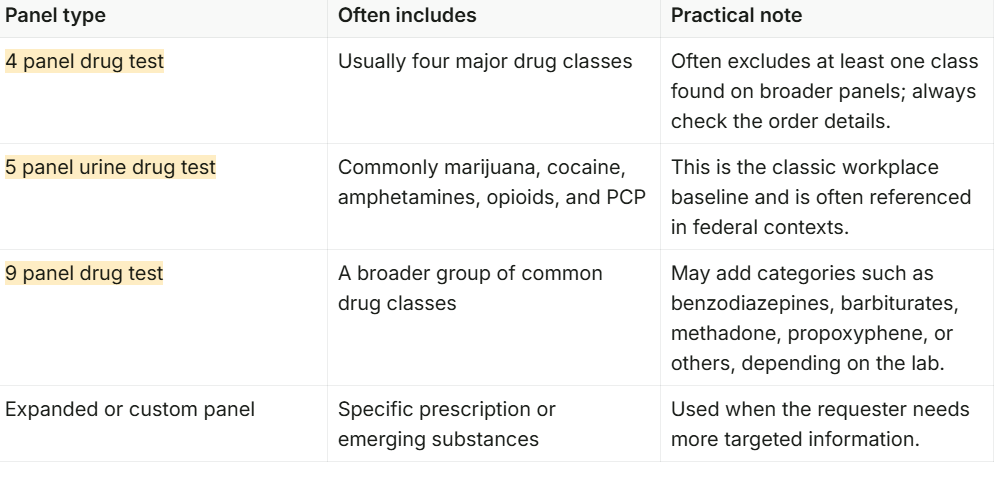
The exact panel matters more than the label. If a form lists an order code or abbreviated test name, the lab or ordering organization is the best source for what is actually included.
Common substances and drug classes
Marijuana and THC metabolites
Many urine tests look for THC metabolites rather than active THC. A positive result generally means the test detected a metabolite associated with cannabis exposure, not that it measured impairment at the time of collection. This distinction is important because workplace, legal, and medical programs may interpret results differently.
Cocaine metabolites
Drug tests usually screen for cocaine exposure through metabolites such as benzoylecgonine. This class is part of the standard federal workplace drug-testing framework. Confirmation testing may be used after an initial presumptive result.
Amphetamines and related stimulants
Amphetamine-class testing may detect substances related to amphetamine, methamphetamine, or MDMA, depending on the panel. Some legally prescribed medications can be relevant to this category, so accurate medication disclosure to the medical review process is important when applicable.
Opioids and opiates
Older “opiate” screens were often focused on substances such as morphine and codeine. Modern panels may separately test for additional opioids, including oxycodone, hydrocodone, fentanyl, buprenorphine, or methadone. A basic panel and an expanded opioid panel can produce very different coverage.
PCP, sedatives, and other categories
PCP is included in many standard workplace panels, even though it may be less commonly discussed than cannabis or opioids. Broader panels may also include benzodiazepines and barbiturates, which are sedative drug classes with legitimate prescription uses as well as misuse potential.
How should you read a drug test order?
Read a drug test order by looking for the specimen type, panel number, drug classes, confirmation language, and the organization requiring the test. A phrase such as “9 panel drug test” is helpful, but it is not enough to know every substance covered.
Use this checklist:
- Specimen type: urine, oral fluid, hair, blood, or breath alcohol testing.
- Panel name: for example, a 4 panel drug test or 5 panel urine drug test.
- Drug classes: the actual categories listed on the order.
- Confirmation method: whether presumptive positives are confirmed by a laboratory method.
- Requester: employer, court, clinic, school, or licensing body.
- Policy language: rules about prescriptions, marijuana, alcohol, retesting, or medical review.
FDA information on drugs-of-abuse tests notes that home-use kits may include a collection cup, test strip/card/cassette, and instructions, while employment and insurance testing products can have different regulatory labeling considerations. In other words, a store-bought test and a formal workplace laboratory process are not automatically equivalent. (fda.gov)
Alcohol testing and alcohol markers
Alcohol may be tested differently from other substances. Some programs use breath testing to estimate current alcohol concentration. Others use urine, blood, or other laboratory testing to look for alcohol or alcohol-related markers.
When people search for answers for the drug and alcohol test, they are often trying to understand what will be asked or measured. The safest, most accurate answer is to review the specific testing policy, disclose legitimate prescriptions through the proper channel, and avoid assuming that a “drug test” automatically includes or excludes alcohol.
Does kratom show up on a drug test?
Kratom does not usually appear on the classic five-class workplace panel unless the test specifically includes kratom-related analytes such as mitragynine. Because standard federal workplace classes focus on marijuana metabolites, cocaine metabolites, amphetamines, opioid metabolites, and PCP, kratom is not one of those core classes. (samhsa.gov)
However, that does not mean kratom can never be tested. Some clinical, legal, treatment, or expanded panels may order specialized testing. If the question is “does kratom show up on a drug test,” the practical answer is: not on many basic panels, but it can show up if the requester orders a test designed to detect it.
Eployer-specific testing questions
Searches like “does Walmart drug test” show how often people want a yes-or-no answer about a specific employer. The problem is that employer policies can vary by role, location, timing, safety sensitivity, post-accident rules, and applicable law. Retail, warehouse, driving, pharmacy, and management positions may not all be handled the same way.
For any employer, rely on the job posting, conditional offer paperwork, hiring contact, or official policy documents. Online anecdotes may be outdated or role-specific, especially when state cannabis laws and company practices change.
Why presumptive and confirmatory results differ
Many drug-testing processes begin with a screening test. If the screen is non-negative or presumptive positive, a laboratory may use confirmatory testing to identify a specific drug or metabolite more precisely. Quest Diagnostics describes drug testing as including presumptive testing to rule out multiple classes and definitive testing for confirmation or for substances where presumptive testing is not available. (questdiagnostics.com)
This distinction matters because screening tests are designed for efficiency, while confirmation is designed for specificity. It is also why official results should be interpreted through the program’s stated process rather than through a home test alone.
Practical takeaways
- A panel number tells you the size of the test, not always the exact substances.
- A 5 panel urine drug test commonly covers marijuana, cocaine, amphetamines, opioids, and PCP.
- A 9 panel drug test is broader, but the added categories vary.
- Kratom usually requires specific testing rather than a basic standard panel.
- Alcohol may be tested separately from drug classes.
- Employer policies should be verified through official hiring or workplace documents.
If you are trying to test drug test wording on a form, focus less on rumors and more on the actual panel name, specimen type, and policy behind it. Those details determine what is being tested, how results are reviewed, and what steps follow after collection.