.png)
Blogs
Blood Analysis in Forensic Science: Modern Techniques & Applications
Advancements in Blood Analysis for Forensics
Blood evidence can help investigators understand what happened, who may have been involved, and how events may have unfolded at a scene. Modern forensic blood analysis combines field screening, laboratory testing, blood type identification, bloodstain pattern analysis, and forensic DNA analysis to turn crime scene blood into carefully interpreted evidence. This guide explains the major techniques, how they work together, and why newer tools are improving speed, sensitivity, documentation, and decision-making without replacing disciplined collection and interpretation.
What does modern forensic blood analysis actually examine?
Modern blood analysis in forensic science examines both the biological identity of a stain and the physical story told by its location, shape, distribution, and condition. A stain may be tested to determine whether it is likely blood, whether it is human, whose genetic profile it may contain, and what the pattern suggests about movement, impact, transfer, or cleanup. The most useful investigations do not treat blood as a single clue; they integrate screening results, lab findings, scene context, and documented observations.
Forensic blood analysis generally falls into two connected areas. The first is biological testing, which asks what the substance is and who it may be associated with. The second is pattern and scene interpretation, which asks where the blood is, how it may have been deposited, and whether the physical evidence supports or challenges a proposed sequence of events.
A single case may involve a presumptive test from a blood kit at the scene, confirmatory laboratory testing, blood type identification in limited contexts, DNA profiling, and bloodstain pattern analysis. Each step has a different purpose. Confusing those purposes can lead to overstatement, so modern practice emphasizes method selection, documentation, quality control, and cautious language.
The role of blood evidence in forensic science
Blood is valuable because it can carry biological information and preserve physical traces of activity. It may appear as visible stains, diluted smears, small droplets, transfer marks, saturation patterns, or traces that are difficult to see without enhancement. It can be found on clothing, weapons, flooring, walls, vehicles, bedding, drains, and many other surfaces.
The presence of crime scene blood does not automatically prove what happened. It must be interpreted in relation to the scene, the people involved, the timeline, and other evidence. For example, blood on a surface may result from injury, transfer, medical intervention, cleanup, or secondary contact. A reliable forensic conclusion depends on linking test results to a documented chain of observations.
Blood evidence can support several investigative questions:
- Whether a stain is likely to be blood or another substance.
- Whether the blood is human or from another species.
- Whether a DNA profile can be developed from the sample.
- Whether more than one contributor may be present.
- Whether the pattern suggests dripping, transfer, impact, cast-off, pooling, saturation, or alteration.
- Whether a stated account is consistent with the physical distribution of stains.
- Whether hidden or cleaned areas may contain additional traces.
These questions show why blood analysis is not one test. It is a sequence of forensic science techniques, each with strengths, limitations, and interpretive boundaries.
Core methods used in forensic blood analysis
Forensic blood analysis usually begins with observation and documentation before any chemical or biological test is applied. Investigators photograph stains, note locations, record environmental conditions, and decide what should be collected. This careful front-end work protects the value of later laboratory results because testing can consume or alter a sample.
Visual examination and documentation
Visual examination is the first layer of evidence handling. Trained personnel look at stain color, shape, distribution, surface type, drying characteristics, and possible signs of disturbance. They also consider whether the material could be paint, rust, food, soil, cosmetic product, or another substance that resembles blood.
Photography is essential. Overall, midrange, and close-up images help preserve spatial relationships and stain detail. Scales, orientation markers, and proper lighting make images more useful for later review. In complex scenes, mapping tools, notes, sketches, and digital reconstruction can help maintain context.
Presumptive blood testing
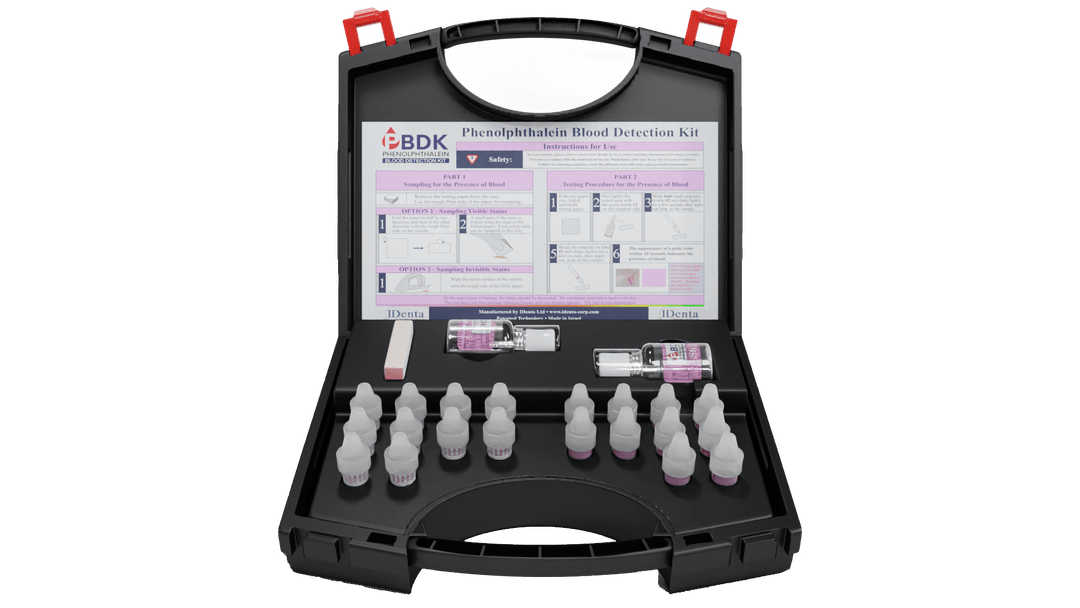
Presumptive tests are used to indicate whether a stain may contain blood. They are often fast, portable, and suitable for screening, which makes them useful at scenes or during evidence triage. A forensic blood kit may include swabs, reagents, controls, collection materials, and packaging supplies, depending on the agency’s protocol.
The key point is that presumptive tests are not final proof. Some substances can react in ways that resemble blood, and environmental conditions may affect results. A positive screening result helps guide collection and further testing; it should not be treated as a complete identification by itself.
Confirmatory testing
Confirmatory testing is designed to provide stronger support that a sample is blood. These tests are typically more specific than presumptive screens and may be performed in a laboratory environment with documented controls. They help reduce the risk of mistaking a look-alike substance for blood.
In practice, the choice of confirmatory method depends on the sample, the laboratory’s validated procedures, and the questions in the case. Small or degraded samples may require careful decisions because some tests may consume material that could otherwise be used for DNA. Modern workflows often balance confirmation with preservation.
Human blood identification
Once a sample is suspected or confirmed as blood, investigators may need to know whether it is human. Species identification can be important when blood may come from pets, wildlife, livestock, food products, or environmental contamination. Human identification testing helps focus later analysis and may prevent misleading assumptions.
This is especially relevant in scenes where animal blood could be present for innocent reasons. A stain in a kitchen, hunting vehicle, farm setting, veterinary clinic, or outdoor area may require a different interpretive approach than a stain in a bedroom or vehicle interior. Context matters at every step.
Blood type identification
Blood type identification was historically important before DNA profiling became widely available. It can still have educational, screening, or limited investigative value, especially when DNA analysis is not possible or when a case requires broader biological context. However, blood type evidence is far less individualizing than forensic DNA analysis.
A blood type can group people into categories, but it usually cannot identify one person to the exclusion of nearly everyone else. This means blood type identification must be described carefully. It may help include or exclude categories of potential donors in some circumstances, but it does not carry the same discriminating power as a suitable DNA profile.
Why has blood evidence become more powerful?
Blood evidence has become more powerful because forensic methods can now extract more information from smaller, older, mixed, or visually challenging samples while preserving better documentation of how results were obtained. Advances in chemistry, DNA technology, imaging, data management, and quality systems have improved both detection and interpretation. The progress is not simply about faster testing; it is about producing results that are more sensitive, more reviewable, and better connected to the original scene.
Earlier forensic approaches often relied more heavily on visible stains, blood grouping, and broad chemical reactions. Those tools remain part of the foundation, but modern forensic science has expanded what can be detected and what can be inferred. A faint trace, a diluted stain, or a complex pattern may now be examined with more options than in the past.
At the same time, greater sensitivity creates new responsibilities. If a test can detect very small amounts of biological material, investigators must consider transfer, contamination, persistence, and alternative explanations. Better technology does not eliminate the need for careful interpretation; it raises the standard for it.
Advances in blood detection and visualization
Detection is often the first challenge. Blood may be obvious, but it may also be diluted, wiped, painted over, exposed to weather, or deposited on dark or patterned surfaces. Newer and improved visualization approaches help investigators locate potential evidence without relying only on the naked eye.
Chemical enhancement of latent or diluted blood
Chemical enhancement can reveal blood traces that are difficult to see. Some reagents are used because they create a visible color change, while others produce light or fluorescence under certain conditions. These methods can help investigators identify areas for photography, sampling, and further testing.
However, chemical enhancement must be controlled. A reagent that helps reveal blood may also affect later tests, alter stain appearance, or spread material if applied carelessly. Good practice includes documenting the scene before enhancement, using appropriate controls, and understanding how the chosen method may interact with downstream forensic DNA analysis.
Alternate light sources and imaging
Alternate light sources can help examiners identify stains, treated areas, or contrast differences on challenging backgrounds. Digital photography, filtered lighting, and image enhancement can improve documentation, especially when stains are faint or visually complex. These tools are particularly useful when combined with careful notes and scale photography.
Imaging does not replace sampling. It supports decision-making by helping examiners see what should be collected, what should be protected, and what patterns deserve closer study. When images are properly captured, they also allow later review by analysts, attorneys, and courts.
Spectroscopy and non-destructive screening
Some modern approaches focus on analyzing stains with minimal or no consumption of the sample. Spectroscopic methods can assess chemical properties of a stain and may assist in differentiating blood from other materials or evaluating stain characteristics. The benefit is obvious: when evidence is limited, preserving material for additional testing matters.
Non-destructive or minimally destructive screening is especially valuable for tiny stains, historic evidence, or items where repeated sampling is impractical. These methods still require validation and careful interpretation, but they reflect a broader trend in forensic science: get more information while consuming less evidence.
Improvements in forensic DNA analysis from blood
Forensic DNA analysis is one of the most important developments in the history of blood evidence. Blood can contain nucleated cells that provide genetic material suitable for profiling. When a usable profile is obtained, it can help associate a sample with an individual, exclude a person, or identify mixtures that require further interpretation.
Greater sensitivity from smaller samples
Modern DNA methods can work with smaller amounts of biological material than older approaches. This is significant because many scenes do not contain large, clean stains. Investigators may be dealing with a tiny droplet, a touch-transfer stain, washed clothing, or a sample exposed to heat, moisture, or sunlight.
The practical benefit is that evidence once considered too limited may now be tested. The practical caution is that small quantities can be more vulnerable to contamination, stochastic effects, and interpretive uncertainty. Collection, packaging, and laboratory controls become even more important when the evidence is scarce.
Better interpretation of mixtures
Blood samples may contain DNA from more than one person. Mixed samples can arise from assaults, shared objects, medical activity, cleanup attempts, or secondary transfer. Interpreting mixtures is more complex than interpreting a single-source profile because the analyst must consider contributor number, relative quantities, and statistical support.
Advancements in software and probabilistic interpretation have improved how complex DNA mixtures can be evaluated. These tools do not make decisions on their own; they assist trained analysts who apply validated procedures and explain the strength and limits of the evidence. Transparency is critical, especially when a mixture plays a central role in a case.
Faster laboratory workflows
Speed matters in active investigations. Improved extraction methods, automated instruments, streamlined quantification, and better sample tracking can reduce delays while maintaining quality. Some settings also use rapid or field-adjacent approaches for specific investigative needs, though confirmatory and evidentiary use depends on jurisdiction, validation, and policy.
Faster workflows can help investigators prioritize leads, identify unknown victims, or rule out irrelevant samples. Still, speed should not be confused with shortcuts. The strongest forensic results are those produced through validated methods, clear documentation, and reviewable quality assurance.
Bloodstain pattern analysis and scene reconstruction
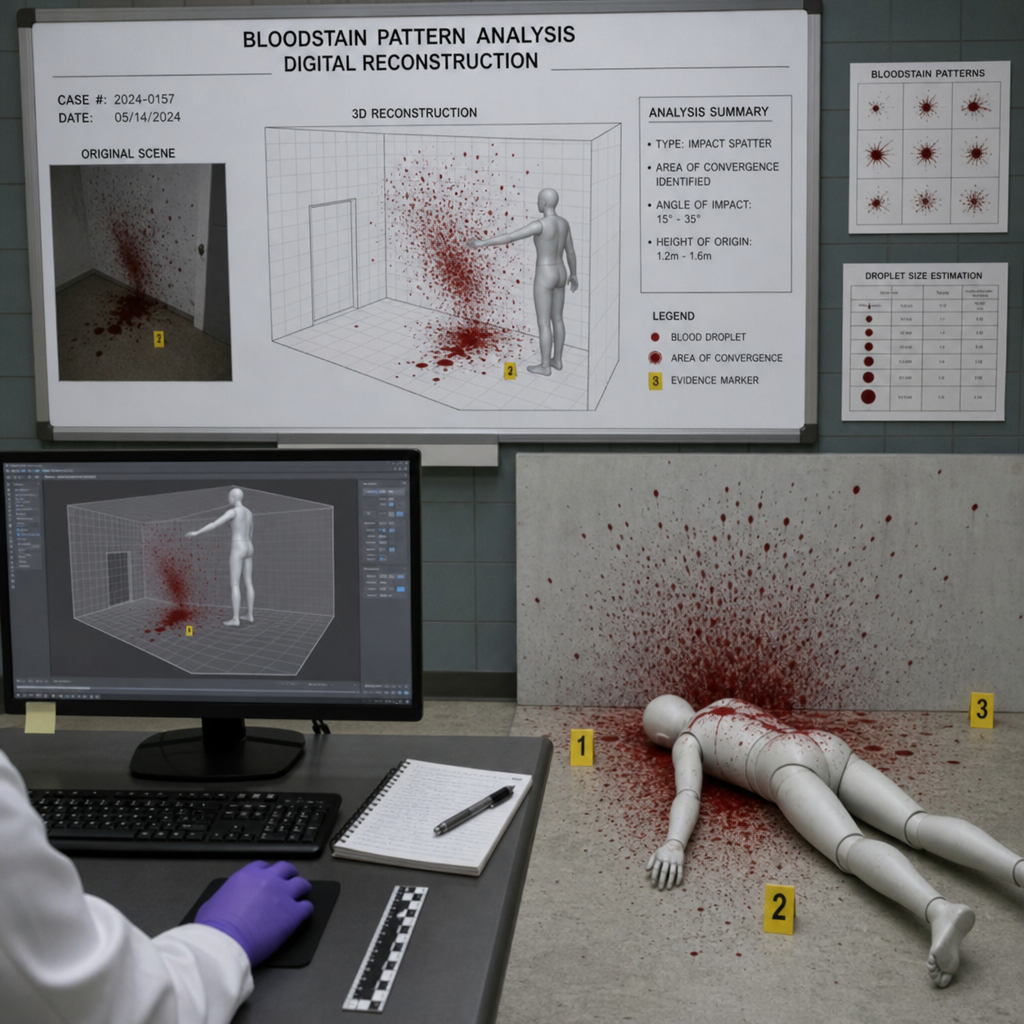
Bloodstain pattern analysis examines the size, shape, distribution, and location of bloodstains to evaluate possible mechanisms of deposition. It may help distinguish passive dripping from transfer, projected blood from cast-off, or saturation from movement through existing blood. When used carefully, it can provide useful context for reconstructing events.
Bloodstain pattern analysis is not simply looking at a stain and naming it. It requires documented observations, an understanding of fluid behavior, attention to surface characteristics, and caution about competing explanations. The appearance of a stain can be affected by the amount of blood, force, angle, height, surface texture, movement, and later disturbance.
Common pattern categories
Pattern terminology helps examiners communicate observations, but categories should not be applied mechanically. A single scene may contain overlapping mechanisms, and some stains may be ambiguous. Useful categories include:
- Passive stains: Blood deposited mainly by gravity, such as drops, pools, or flows.
- Transfer stains: Blood moved from one surface to another through contact, such as wipes, swipes, footwear impressions, or hand marks.
- Impact patterns: Small stains created when force is applied to a blood source.
- Cast-off patterns: Blood released from a moving object, often forming linear or arcing distributions.
- Saturation stains: Blood absorbed into porous materials such as fabric, carpet, or bedding.
- Altered stains: Blood affected by wiping, dilution, cleaning, movement, insects, weather, or later activity.
These categories support analysis, but they do not automatically answer who caused the stain or why. The interpretation must remain tied to the documented scene and the limits of the evidence.
Digital tools for pattern documentation
Digital photography, three-dimensional scanning, scene mapping, and specialized software can improve blood stain analysis by preserving spatial relationships. These tools can help examiners revisit a scene virtually, compare proposed trajectories, or communicate findings more clearly. They are especially useful in large, complex, or cleaned scenes where physical access may be limited after evidence collection.
Technology improves documentation, but it does not remove the need for trained judgment. Software outputs depend on the quality of input data, the assumptions used, and the analyst’s understanding of the scene. Modern best practice treats digital tools as aids, not substitutes for critical evaluation.
How blood testing kits support field investigations
Blood testing kits help investigators screen suspected stains, collect samples, and preserve evidence for laboratory analysis. A well-designed blood analysis kit supports consistency by providing appropriate tools in one place, reducing improvisation at the scene. The kit is only as reliable as the training, protocols, and documentation used with it.
A typical field workflow may include visual inspection, photography, presumptive testing, sample collection, drying if required by protocol, packaging, labeling, and chain-of-custody documentation. The details vary by agency and case type, but the goal is the same: collect useful evidence while minimizing contamination and preserving context.
What a forensic blood kit may include
A blood kit or set of blood testing kits may contain different items depending on whether it is intended for screening, collection, training, or laboratory use. Common categories include:
- Sterile swabs or collection devices for wet or dry stains.
- Presumptive test reagents and instructions.
- Positive and negative control materials where appropriate.
- Personal protective equipment to reduce contamination and protect personnel.
- Evidence envelopes, boxes, or breathable packaging materials.
- Labels, seals, documentation forms, and chain-of-custody materials.
- Distilled or sterile water for moistening swabs when allowed by procedure.
- Measuring scales, markers, or photo documentation aids.
The value of a blood analysis kit is not just convenience. It helps standardize work in stressful environments, supports cleaner collection practices, and makes it easier to follow agency procedure from the first observation through submission to the lab.
Field testing versus laboratory testing
Field testing is useful for screening and prioritization. It can help investigators decide whether a stain should be collected, whether more searching is needed, or whether a location may require additional documentation. Laboratory testing is usually needed for stronger identification, DNA profiling, species determination, and formal reporting.
The distinction matters because field tests can be misused if their purpose is misunderstood. A positive presumptive result is a lead, not the entire conclusion. A negative result may also require caution if the sample is degraded, diluted, chemically altered, or present in very small amounts.
A practical workflow for crime scene blood evidence
A clear workflow protects the integrity of blood evidence from discovery to analysis. The sequence may vary depending on local policy, legal requirements, and scene conditions, but the principles remain consistent. Investigators should prioritize safety, documentation, contamination control, preservation, and communication with the laboratory.
A practical blood evidence workflow includes:
- Secure and assess the scene. Limit access, protect potential stains, and identify hazards before beginning close examination.
- Document before touching. Photograph and note the condition, location, scale, lighting, and surrounding context of suspected blood.
- Use appropriate personal protective equipment. Gloves, masks, protective clothing, and tool changes can reduce contamination and protect personnel.
- Screen only when useful. Apply presumptive tests strategically, not randomly, and document the result and test location.
- Collect the best available sample. Choose representative stains, areas likely to contain biological material, and controls when required.
- Package correctly. Prevent moisture buildup, cross-contact, leakage, and loss of trace material according to evidence protocols.
- Maintain chain of custody. Label, seal, log, and transfer evidence so every handoff is documented.
- Communicate case questions. Tell the laboratory what investigators need to know, such as whether DNA, species testing, or pattern interpretation is most important.
- Review results in context. Interpret lab findings alongside scene documentation, witness accounts, medical information, and other physical evidence.
This workflow is deliberately cautious. Blood evidence can be powerful, but it can also be compromised by poor handling, premature assumptions, or incomplete documentation.
Quality control and contamination prevention
Contamination prevention is central to forensic blood analysis because modern tests can be highly sensitive. Biological material can transfer from hands, clothing, tools, packaging, surfaces, or previously handled evidence. Once contamination occurs, it can be difficult to explain or remove from the interpretation.
Quality control begins before the sample reaches the laboratory. Scene personnel should change gloves between items, avoid talking directly over evidence, use clean tools, separate items during packaging, and document any unusual circumstances. Laboratories then add their own controls, including validated methods, reagent checks, extraction controls, analyst review, and instrument maintenance.
A useful contamination-control checklist includes:
- Photograph and record evidence before sampling.
- Handle one item or stain area at a time.
- Change gloves frequently, especially between samples.
- Use sterile or cleaned tools according to protocol.
- Keep known reference samples separate from questioned evidence.
- Package wet and dry items according to agency requirements.
- Avoid plastic packaging for damp biological evidence unless protocol specifically allows temporary use.
- Seal and label every item clearly.
- Record who collected, handled, transferred, and received the evidence.
- Report possible contamination events rather than hiding them.
The final point is important. Forensic reliability depends on transparency. A documented problem can be evaluated; an undocumented problem can damage the entire evidentiary value of a case.
The limits of blood analysis in forensic science
Blood analysis can answer important questions, but it cannot answer every question. A DNA profile may associate a person with a bloodstain, but it does not automatically explain when the blood was deposited, how it got there, or whether the person committed an act. Bloodstain pattern analysis may suggest possible mechanisms, but it must account for uncertainty and alternative explanations.
One common limitation is timing. Determining the exact age of a bloodstain is difficult because drying, color, degradation, and chemical changes depend on many variables. Temperature, humidity, sunlight, surface type, airflow, cleaning agents, and biological condition all affect appearance. Investigators should be careful about making precise timing claims unless supported by validated case-specific analysis.
Another limitation is context. Blood on clothing might come from injury, assistance, assault, transfer, or shared space. A small stain in a vehicle might be connected to a crime, an accident, a medical event, or an unrelated earlier incident. Forensic science helps evaluate possibilities, but it works best when combined with a complete investigation.
Ethical and legal considerations
Blood evidence often carries emotional weight because it is associated with injury, violence, or death. That makes careful communication essential. Analysts and investigators should explain what the evidence supports, what it does not support, and where uncertainty remains.
Forensic reports should avoid overstating conclusions. A result may be consistent with a proposed event, but consistency is not the same as proof. Likewise, a DNA association may be strong, but the significance depends on sample quality, mixture interpretation, possible transfer, and the case context.
Ethical practice also includes respect for privacy. Forensic DNA analysis can reveal sensitive biological associations, so reference samples, database searches, and retained profiles must be handled according to legal and policy requirements. Responsible use builds trust in forensic science and protects the rights of everyone involved.
How should agencies choose and use blood testing kits?
Agencies should choose blood testing kits based on validated performance, intended use, training requirements, compatibility with laboratory procedures, and clear documentation needs. A kit used for field screening is not the same as a complete laboratory method, and a blood analysis kit should support the agency’s evidence workflow rather than create a separate, informal process. The best kit is one that trained personnel can use consistently, safely, and transparently.
Selection should begin with the case environment. Patrol officers, crime scene technicians, forensic nurses, laboratory analysts, and training programs may need different materials. A kit used outdoors in low light has different practical demands than one used in a controlled lab or classroom setting.
Important selection factors include:
- Purpose: Screening, collection, training, documentation, or laboratory preparation.
- Sample type: Wet stains, dry stains, diluted stains, clothing, hard surfaces, porous materials, or suspected cleanup areas.
- Validation: Whether the method has been evaluated for the intended setting and surfaces.
- Controls: Whether the kit supports positive and negative checks where appropriate.
- Compatibility: Whether reagents or collection materials interfere with later DNA analysis.
- Packaging: Whether supplied containers protect biological evidence during transport.
- Instructions: Whether procedures are clear enough for trained users under real scene conditions.
- Shelf life and storage: Whether materials can be stored reliably and tracked before use.
- Documentation: Whether labels, seals, and forms support chain-of-custody requirements.
- Training burden: Whether users understand limitations, safety, and interpretation.
Even strong tools can produce weak evidence if they are used without training. Agencies should reinforce that a blood kit is part of a broader forensic process, not a shortcut to a conclusion.
Emerging directions in forensic blood analysis
The future of forensic blood analysis is moving toward more sensitive testing, better preservation of limited samples, improved digital documentation, and more transparent interpretation. These developments are practical, not just technical. They help investigators work more efficiently while creating records that can be reviewed and challenged.
Microfluidics and lab-on-a-chip concepts
Miniaturized testing platforms are designed to process very small sample volumes in controlled channels or compact devices. In forensic settings, the appeal is clear: faster screening, reduced reagent use, and less sample consumption. These systems may be especially useful when evidence is scarce or when early investigative information is needed.
Adoption depends on validation, reliability, cost, training, and legal acceptance. A promising device still needs to perform under real forensic conditions, including degraded samples, mixed materials, environmental exposure, and varied surfaces. The direction is encouraging, but implementation must remain evidence-led.
More advanced DNA sequencing
Advanced sequencing approaches can provide deeper genetic information than traditional profiling in some contexts. They may help with degraded samples, mixture analysis, ancestry-related investigative leads where legally permitted, or difficult identification cases. These methods require careful governance because they can raise privacy and interpretation concerns.
For routine casework, the most important question is not whether a technology is advanced, but whether it is appropriate. Laboratories must consider validation, reporting standards, database compatibility, statistical interpretation, and legal admissibility. More data is useful only when it can be explained responsibly.
Artificial intelligence and pattern support
Artificial intelligence and machine learning may support image sorting, stain detection, pattern classification research, and case management. These tools can help identify areas of interest or reduce repetitive review tasks. In bloodstain pattern analysis, computational tools may assist with modeling or visualization.
The caution is that AI should not become an unexplained authority. Forensic conclusions require transparency, validation, error awareness, and human accountability. If an algorithm influences a decision, investigators and courts need to understand what it did, what data shaped it, and where it may fail.
Better data integration
Modern investigations often involve photographs, laboratory results, DNA data, scene maps, body-worn camera footage, reports, and case notes. Better digital systems can help connect these materials so analysts and investigators do not work in isolation. Strong data integration improves traceability and reduces the risk that important context is lost.
This is a quieter advancement than a new reagent or instrument, but it can be just as valuable. Forensic work depends on continuity. The better the information chain, the easier it is to evaluate what was found, how it was handled, and what it means.
Best practices for interpreting blood evidence
I/nterpretation is where forensic blood analysis becomes most consequential. Test results, stain patterns, and DNA profiles must be framed in language that accurately reflects their strength and limits. Good interpretation avoids both exaggeration and unnecessary hesitation.
Best practices include:
- Separate observation from interpretation. Describe what was seen before explaining what it may mean.
- Use the least speculative conclusion that fits the evidence.
- Consider multiple mechanisms for stain deposition.
- Distinguish screening results from confirmatory findings.
- Explain whether DNA findings indicate a single source, mixture, exclusion, or inconclusive result.
- Avoid precise timing claims unless supported by validated analysis.
- Review scene context before finalizing conclusions.
- Make limitations visible in reports and testimony.
- Use peer review or technical review where required.
- Update interpretations if new evidence changes the case context.
These practices protect the investigation and the people affected by it. Blood evidence can be compelling, so it must be presented with discipline.
Training remains the foundation
Advancements in forensic science techniques are only useful when people understand how to apply them. Training helps users know when to test, when to collect, when to stop, and when to ask for specialized support. It also helps prevent common mistakes such as overhandling evidence, mislabeling samples, misreading presumptive tests, or ignoring scene context.
Training should include both science and scenario-based practice. Personnel need to understand why a presumptive test can be useful but limited, how packaging affects biological evidence, why controls matter, and how bloodstain pattern terminology should be used. They also need experience documenting scenes under realistic pressure.
For agencies, training should not end with initial certification or onboarding. Refresher sessions, proficiency exercises, case reviews, and updates on validated methods help keep practice aligned with current expectations. The tools may change, but the need for careful observation and honest reporting does not.
Bringing the science and the scene together
The strongest forensic blood analysis connects laboratory precision with scene-level context. A DNA result can tell investigators whose biological material may be present, while bloodstain pattern analysis can help evaluate how the material may have been deposited. Screening tests, blood testing kits, imaging tools, and documentation systems all support that larger goal.
The major advancement is not one single technique. It is the integration of sensitive testing, better visualization, improved evidence handling, clearer reporting, and more disciplined interpretation. When these pieces work together, blood evidence becomes more useful and less vulnerable to misunderstanding.
Forensic professionals should approach every bloodstain with the same balanced mindset: preserve first, test carefully, interpret cautiously, and explain clearly. That combination is what turns a stain into reliable evidence and helps forensic science serve the investigation rather than merely impress it.
Check out our PBDK for the ideal blood forensic testing kit.