.png)
Blogs
Ballistic Forensics: Techniques & Evidence Explained
Understanding Ballistic Forensics: Techniques and Applications
Ballistic forensics sits at the crossroads of physics, firearms engineering, and criminal investigation. When a gun is fired, it can leave behind a trail of measurable clues—on the bullet, the cartridge case, surrounding surfaces, and even in the air. By studying these clues through ballistic analysis, investigators can reconstruct events, connect shootings across locations, and sometimes answer the question people most often ask: how to match bullets to guns reliably.
This guide explains what ballistic forensics is, how it works in practice, and where it can help (and fail) in real cases—without the TV-magic hype.
What Is Ballistic Forensics?
Forensic ballistics is a branch of forensic science focused on firearms, ammunition components, and the effects of gunfire. In simple terms, it’s the study of ballistic evidence to support investigations and court proceedings.
Ballistic forensics typically covers three big areas:
- Firearms identification techniques (linking a bullet or cartridge case to a specific firearm)
- Bullet trajectory and shooting reconstruction (direction, distance, angles, and paths)
- Forensic evidence related to firing (e.g., gunshot residue testing methods, muzzle-to-target distance indicators, and damage patterns)
A key idea is that firearm parts can leave distinctive marks on ammunition components. This is often described as a ballistic fingerprint—but that phrase is more of a helpful metaphor than a perfect analogy.
So, what is a ballistic fingerprint? It’s the pattern of microscopic marks a firearm can impart onto a bullet and/or cartridge case during firing and cycling—marks that may be compared against test-fired samples in ballistic testing.
How Ballistic Evidence Is Created (Bullet vs. Cartridge Case)
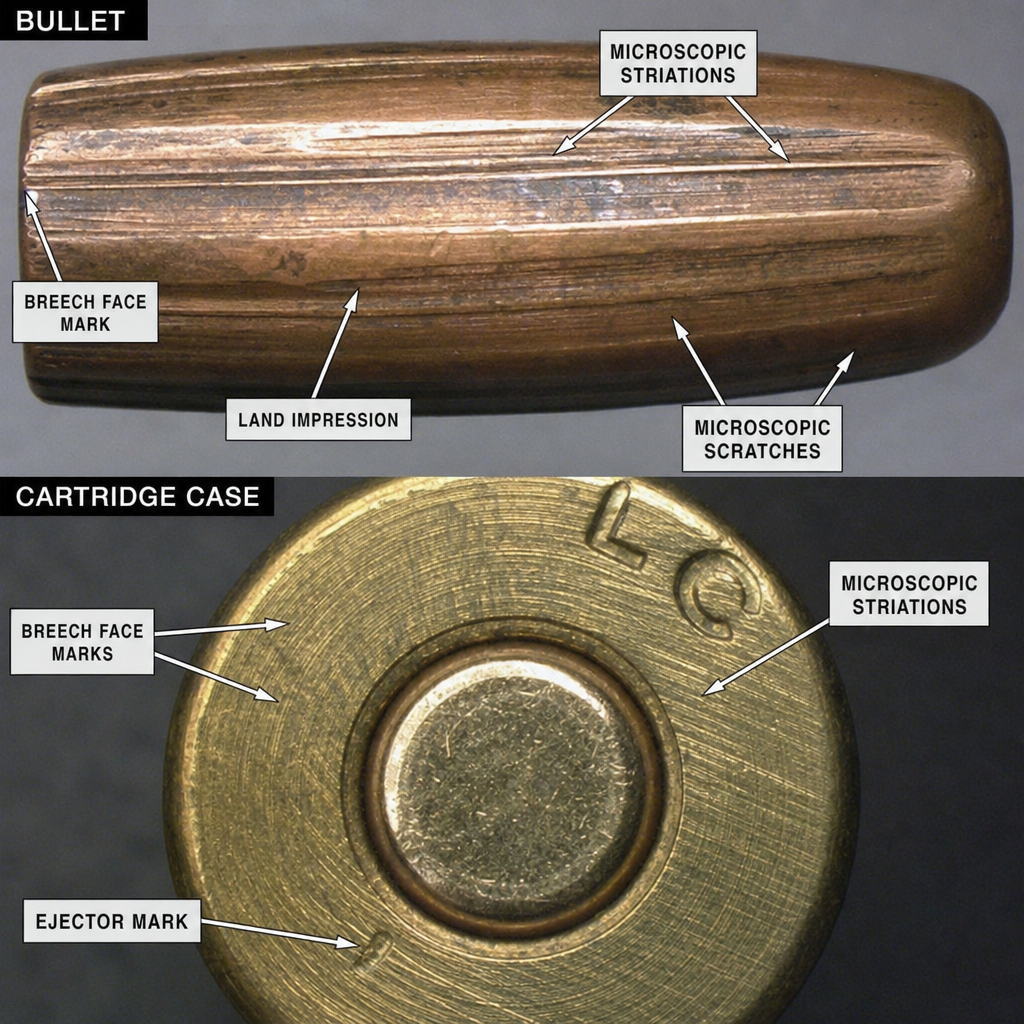
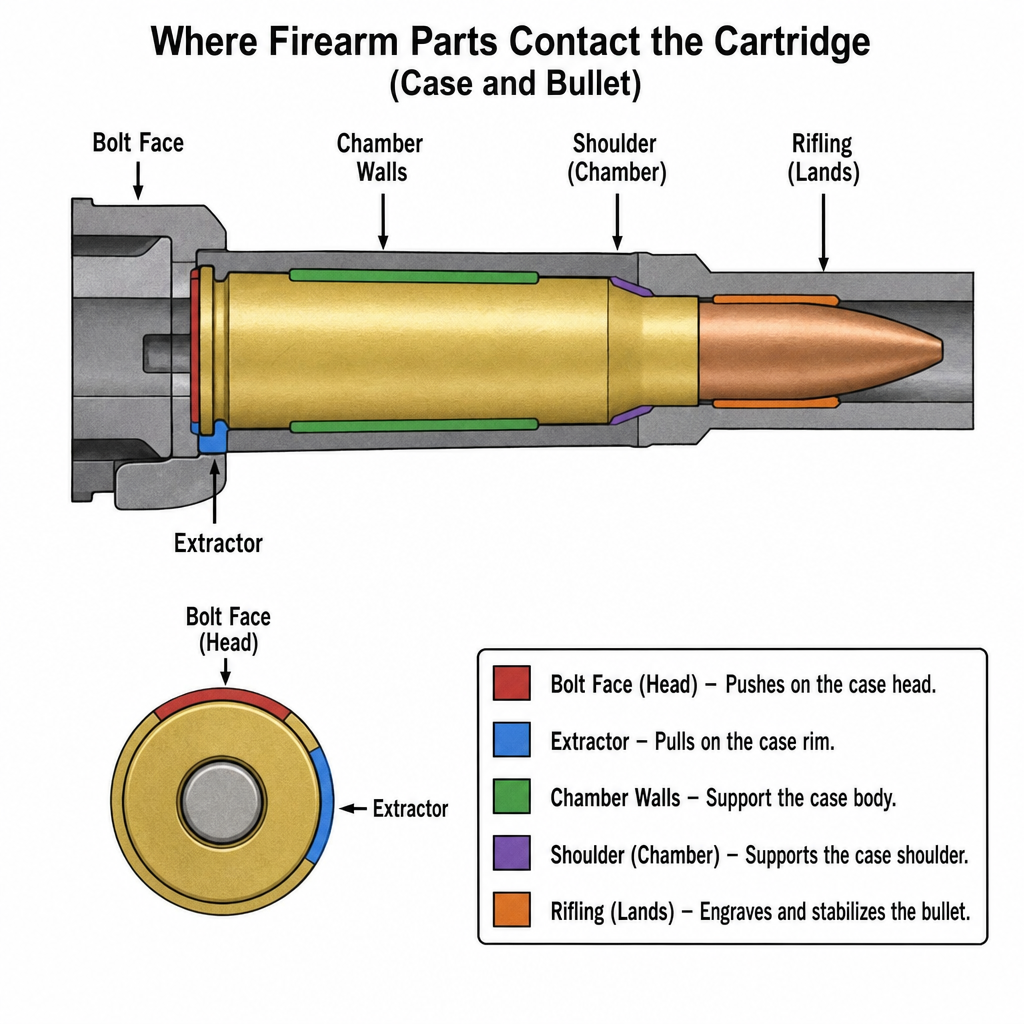
When a firearm discharges, different surfaces can mark different evidence items. Understanding rifling marks vs breech face marks is foundational.
Bullet toolmarks: rifling impressions
Inside many barrels are spiral grooves called rifling. As a bullet travels through the barrel, it can pick up:
- Land-and-groove impressions
- Microscopic striations (fine scratches) along those impressions
This is where bullet striation analysis comes in—examiners compare those fine striation patterns to see whether they are consistent with a specific barrel.
Cartridge case toolmarks: breech face and more
Semi-automatic pistols and many rifles eject a cartridge case after firing. The case can show marks from:
- Breech face (the rear surface the case slams against)
- Firing pin impression
- Extractor and ejector marks
- Chamber marks
These are often examined through cartridge case comparison microscopy, because cartridge cases can preserve very strong, detailed marks.
Practical takeaway: In many handgun cases, cartridge cases may provide more consistent identification features than deformed or fragmented bullets—though every case is different.
Core Techniques in Ballistic Forensics (Step-by-Step)
1) Crime scene ballistic evidence collection
The accuracy of any later comparison depends heavily on crime scene ballistic evidence collection. Evidence can be lost, contaminated, or damaged before it ever reaches a lab.
Key collection tips (high level):
- Photograph items in place before moving them.
- Package bullets and cartridge cases separately to avoid new scratches.
- Document exact location, orientation, and surface context.
- Collect “associated” items: magazines, ammunition boxes, firearm accessories, and potential impact materials.
This work is part of building strong forensic evidence that can be explained and defended later.
2) Ballistic evidence chain of custody
A clean ballistic evidence chain of custody is non-negotiable. If the documentation is sloppy, evidence can be challenged—even if the science is solid.
Minimum best practices:
- Unique identifiers per item (barcode or sealed evidence label)
- Tamper-evident packaging
- Time-stamped transfer logs (who/when/why)
- Clear notes on any test-firing or handling in the lab
3) Ballistic testing and test fires
In controlled ballistic testing, a firearm (if recovered) is test-fired using suitable ammunition into a recovery system (often a water tank or soft media) to preserve bullets and cases.
The test fires provide known samples for comparison.
4) Microscopic comparison (traditional)
The classic lab workhorse is the comparison microscope. People sometimes search for the “best ballistic comparison microscope,” but in practice the “best” depends on:
- Optical quality and illumination control
- Stable stage and smooth positioning
- Integrated digital capture
- Compatibility with lab workflow and validation requirements
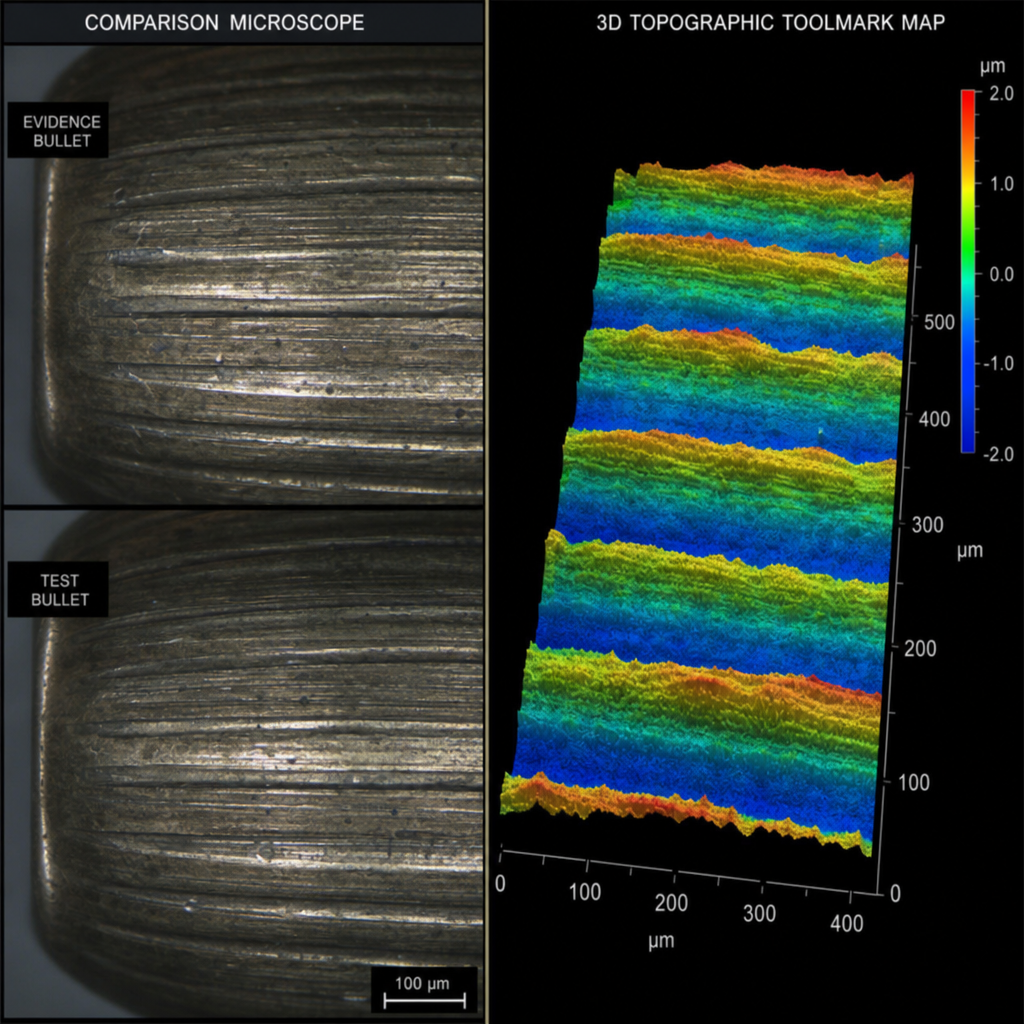
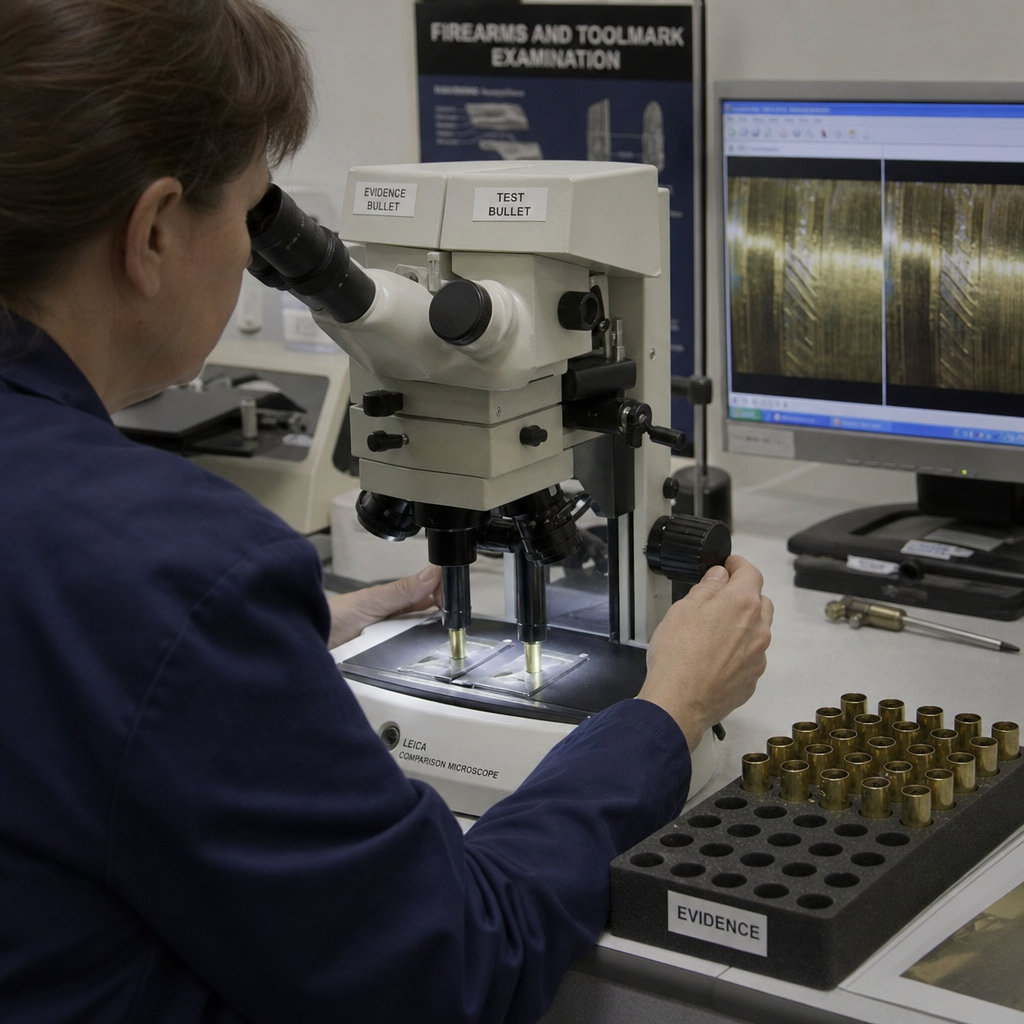
A trained examiner uses the comparison microscope to view two items side-by-side, assessing whether toolmarks show sufficient agreement.
5) 3D ballistic imaging systems
Modern labs increasingly use 3D ballistic imaging systems to digitize toolmark surfaces and support objective measurement. These systems can:
- Produce topographical maps of toolmarks
- Assist with database searches
- Improve documentation and peer review
Important note: 3D tools typically support (not replace) human examiner conclusions, depending on jurisdiction, validation, and lab policy.
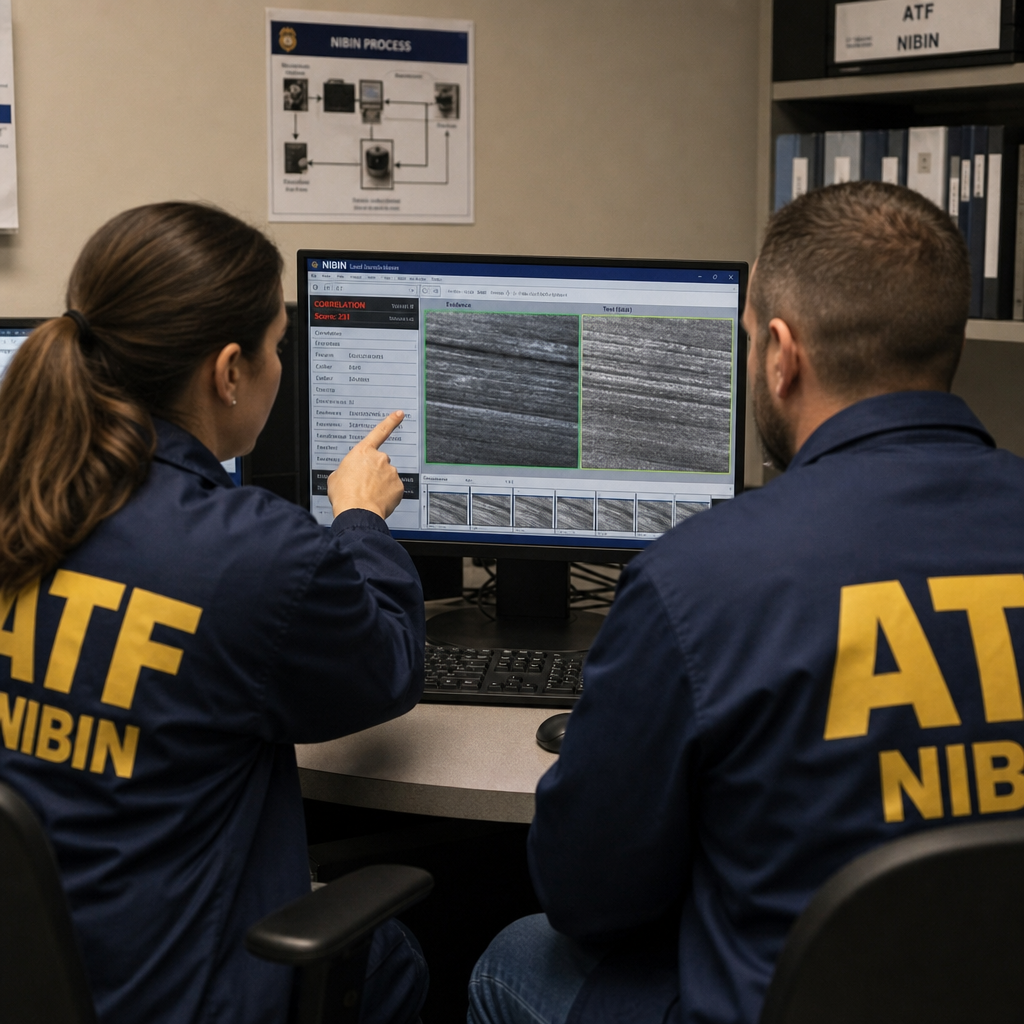
NIBIN: Linking Shootings at Scale
The National Integrated Ballistic Information Network (NIBIN) is a U.S. network that helps law enforcement correlate cartridge cases from different incidents. In simplified terms, NIBIN supports:
- Capturing images/data from cartridge cases
- Searching for potential correlations (“leads”)
- Connecting cases that may involve the same firearm
It’s crucial to understand what NIBIN does and does not do:
- Does: Generate investigative leads for follow-up examination
- Does not: Automatically “prove” a match by itself in court
NIBIN leads still require careful examination and confirmation processes according to lab standards.
Bullet Trajectory and Shooting Reconstruction
Beyond identification, bullet trajectory work can help reconstruct what happened. Trajectory analysis may involve:
- Mapping bullet holes and impact points
- Determining line-of-flight angles
- Assessing possible shooter positions
- Evaluating intermediate targets (glass, drywall, vehicle panels)
Common tools and methods include:
- Stringing/laser trajectory kits
- 3D scene scanning and photogrammetry
- Rods inserted into bullet defects/holes (when appropriate)
- Measuring bullet deflection after intermediate impacts
Actionable example: trajectory “sanity checks”
If you’re documenting a scene, record:
- Height of bullet defects from floor/ground
- Angles relative to walls and corners
- Material type at each impact point
- Directionality indicators (spall, beveling, wipe patterns)
These details help examiners evaluate whether proposed trajectories are physically consistent.
Gunshot Residue (GSR): What It Can (and Can’t) Prove
Gunshot residue testing methods generally look for primer and combustion byproducts on hands, clothing, or nearby surfaces.
Typical considerations include:
- Timing: Residue can be lost quickly through washing, rubbing, or environmental exposure.
- Transfer: GSR can transfer via contact, complicating interpretation.
- Context: Presence may indicate firing, proximity to a discharge, or handling a recently fired weapon—interpretation depends on the full case picture.
GSR is often best used as corroborative forensic evidence, not a standalone answer.
Firearms Identification Techniques: How Matches Are Made
When people ask “how to match bullets to guns,” they’re asking about the logic and limits of toolmark comparisons.
What examiners look for
Depending on the evidence, examiners may compare:
- Bullet land-and-groove impressions and striations (bullet striation analysis)
- Breech face marks, firing pin impressions (rifling marks vs breech face marks)
- Extractor/ejector patterns
- Chamber marks
What conclusions may look like
Labs can differ, but common outcome categories include:
- Identification (evidence is consistent with the same source)
- Elimination (inconsistent with the same source)
- Inconclusive (insufficient detail or ambiguous marks)
A careful report explains not just the conclusion, but the basis and any limitations.
Common Causes of Ballistic Match Errors (and How Labs Reduce Risk)
No forensic method is immune to error. Understanding common causes of ballistic match errors helps investigators, attorneys, and jurors evaluate strength appropriately.
Frequent contributors include:
- Poor-quality evidence: Deformed bullets, corrosion, fire damage, or low-detail marks
- Subclass characteristics: Manufacturing patterns shared across parts from the same production process
- Ammunition variability: Different loads and materials can affect mark clarity
- Firearm wear/alteration: Replacement barrels, worn breech faces, or intentional modifications
- Contamination/handling: New scratches created during collection or transport
- Cognitive bias: Contextual case details influencing interpretation if safeguards aren’t used
Risk-reduction practices often include:
- Verification/peer review by another qualified examiner
- Context management (limiting unnecessary case details)
- Standard operating procedures and validation studies
- High-quality imaging and documentation, including 3D tools where validated
- Ongoing proficiency testing and audits
Alternatives to Traditional Ballistic Matching (and When They Help)
There’s increasing interest in alternatives to traditional ballistic matching—not necessarily to replace microscopy, but to strengthen objectivity, reproducibility, and transparency.
Examples include:
- Algorithm-assisted correlation from imaging platforms (often used for triage and lead generation)
- Quantitative comparisons using surface topography from 3D ballistic imaging systems
- Statistical/likelihood-based reporting approaches (in some research and limited operational settings)
- Enhanced documentation and standardized decision frameworks to improve consistency
These approaches can be particularly helpful when:
- Toolmarks are partial or borderline
- Large volumes of cases require triage
- Independent review and courtroom demonstratives are important
The best practice is usually a hybrid workflow: objective measurement tools plus expert interpretation, backed by documented procedures and verification.
Best Practices for Stronger Ballistic Cases (Practical Tips)
Whether you’re in law enforcement, legal work, or forensic support, you can strengthen outcomes by focusing on inputs and documentation:
- Prioritize cartridge cases when available; they often preserve rich toolmarks for cartridge case comparison microscopy.
- Keep bullets/cases separated and cushioned in packaging to avoid new marks.
- Document scene geometry early to support bullet trajectory work later.
- Treat every transfer as a courtroom moment: maintain ballistic evidence chain of custody with clean, consistent records.
- When discussing results, distinguish:
- NIBIN “leads” (investigative) vs. confirmed lab conclusions
- Identification vs. inconclusive outcomes
- If a firearm is recovered, request ballistic testing with appropriately selected ammunition and clear questions for the lab.
Training and Competency: The Human Factor
Ballistic work is not just equipment—it’s expertise. Forensic firearms examiner training typically involves:
- Structured coursework in firearms/ammunition function
- Extensive supervised comparisons across many evidence types
- Competency assessments and ongoing proficiency testing
- Familiarity with lab quality systems and reporting standards
A well-run lab treats training, documentation, and verification as core scientific controls—not administrative afterthoughts.
Conclusion: What Ballistic Forensics Does Best
At its best, ballistic forensics turns subtle toolmarks and scene physics into clear investigative direction: linking incidents, supporting timelines, and clarifying what could (and could not) have happened. Strong outcomes come from careful crime scene ballistic evidence collection, disciplined ballistic evidence chain of custody, validated methods (including 3D ballistic imaging systems when appropriate), and transparent reporting that acknowledges limitations and error sources.
Takeaway: The most persuasive ballistic conclusions aren’t the ones that sound absolute—they’re the ones that are well-documented, verified, and consistent with the overall forensic evidence.
See our BTK Suitcase by clicking here.